Experience Life – Don’t Just Live IT!

The old proverb, “experience is the best teacher” rang true this week as I discovered another accurate saying, “you are never too old to learn something new.” It was, it is, and it will always be true.  I’ve heard that experience gives you the test first and the lesson afterwards.  Some of us may need more experience than others when it comes to learning our lessons. More than often, I fall into that category, but not this past week. This week, I experienced three incredible lessons that I learned rather quickly. I’ts no wonder, I had the best teachers –  my grandchildren!

Here is what I learned.

  1. Grandchildren are better than ice cream on a hot day.
  2. Grandchildren are better at hearing and listening than we think they are.
  3. Grandchildren are better at taking you out of your comfort zone than you are yourself.

Let me explain.

My 18 year old, incredibly busy granddaughter, texted me at 1:30 p.m. “Grammy, you want to hang out together later this afternoon and maybe go to the pool?  I have until 6:00 p.m.?” I quickly replied in the affirmative knowing that this granddaughter typically has very little time to spare. Several minutes later she texted again, “I have to work late, sorry, no time for swimming.” I responded that maybe we could just grab dinner and she replied, “COOL!”

At five o’clock she texted, “Still at work, “Can’t do dinner. How about ice cream instead?” I never say no to ice cream on a hot day so I agreed. At 5:45 p.m., Maria and I met at the frozen yogurt shop.  As we sat talking about her upcoming class schedule, her stage managing, various shows in the works, our mutual passion for sorbet and her healing foot still in the boot, I realized this experience was a keeper. Her big blue eyes danced as we exchanged smiles and hugs good-bye – until the next time.

These brief 15 minutes were far better than the cool sorbet ice cream we enjoyed together.  She had to leave at 6:00 p.m. That was the best 15 minutes of my day.

My two younger granddaughters, 9 and 11 came for one of their Grammy sleepovers. We played games, went to the pool, ran a few important errands and had pizza, of course. As is our custom, we went to church on Sunday. The girls walked hand-in hand to find seats where they waited for my signal to pull out their coloring books. Busy creating the most extraordinary pictures, they hardly noticed that the service was over. As we made our way back home, I asked if they heard or learned anything from the sermon.

Much to my surprise, they both summed it up in one sentence. “If you don’t have love for others then what’s the point?” That brought a huge smile to my face. I was tempted to send their shortened version to the pastor, but decided that it was meant for me. Alexis and Anya added, “it matters less what you say than what you actually do.” They also chuckled telling me that they were listening while they were coloring and reminded me that you can do more than one thing at a time.

We all laughed, but I knew that this experience was another keeper. These morsels of wisdom were far better than any sermon I’ve ever heard.

During a brief visit with my 14 year old grandson, he described his efforts to build a demo derby car from spare parts. I know very little about cars and nothing about demo derby ones, but his face beamed with excitement at the possibility of telling me everything I ever wanted to know. How could I refuse?

He explained the kind of paint needed, the type of engine he wanted and the specific tires that he might use. Details included the nuts and bolts holding it together along with a YouTube visual for the demo-derby challenged like his Grammy. I asked questions, he eagerly responded with patience and expertise.

I found myself relishing this moment simply due to the sparkle in his eyes as he shared his passion with me. I knew it was another keeper experience. Although stretched a bit out of my comfort zone, I can talk demo derby with some confidence thanks to Nathanael’s tutoring.

Experience is definitely the best teacher, especially when it’s with your grandchildren. There is absolutely nothing better.

You Say You Want A Revolution?

Maybe it’s my age or the variety of good music I heard growing up, but some lyrics seem to live well beyond their years. The song Revolution, penned by the Beatles in 1968, lamented the Vietnam War and rang true for so many anti-war protesters. In the midst of a very unpopular and long quagmire where thousands of lives were lost, no real victory was realized as embattled troops returned to a seemingly unappreciative and event hostile homecoming. It was a challenging time for sure.

We all want to change the world right?

Anytime we find ourselves in a situation that seems inescapable we might consider how we ended up there and what we can do moving forward. War is evil yet sometimes inevitable. It wreaks havoc on all those involved (countries, soldiers, and innocent civilians) and leaves indelible damage long after victory is proclaimed. Just ask any veteran who is willing to honestly share their thoughts.

Notice to my young children 1974-1999

no guns allowed (4)

As a young mother, I forbid my children to have toy guns, not even a water pistol. Crazy some may say, but I could not in good conscience allow something in my home that I abhorred. I don’t think my children were damaged by my rigid adherence to this particular rule. In fact, one of my sons served three tours in Afghanistan and came back alive, no doubt due to his keen skill using a high powered rifle. Apparently not owning a toy gun for 18 years did not handicap his ability to defend himself, protect his troops, and to ward off the enemy.

The sad truth is, that in war, there will be casualties.

Why do I write about war and revolutions? Simply put, I believe there is a war for the minds of young people in a world of schooling that does not emphasize authentic learning. I believe that we accept this status quo because of compulsory school laws. We are told that public school ensures educational equity while training young people to become productive citizens. We believe that young people need to be formally trained and taught so they can take their rightful place in society. Cookie cutter classes producing the same kind of cookie is the goal.

You tell me it’s the institution
Well, you know
You’d better free your mind instead

Free thinking for students is not on most K-12 public school agendas. The institution honors conformity, compliance and coercion.  It is designed to keep order among the masses entering the school house doors on a daily basis. While it may recognize brilliant children, it is often too busy classifying them into the right box. There is little veering from the set grade level curriculum because it is too costly and time consuming to do other wise.

Creativity, innovation and grit are taught in metered doses through various checklists that good teachers try, all while ensuring that their students are ready to take the high stakes state tests every spring. Rigid time constraints, a plethora of testing, and cumbersome standards ensure that little time is left for authentic and meaningful learning.

We continue the practice of forcing all the square pegs into our round holes. The casualties are inevitable.

“Our students are products of what we model. Teach them dependence and submission and they comply. Teach them that certain behaviors trigger rewards and they catch on to the cues. Teach them to sit and raise hands and speak only when spoken to and they acquiesce over time. Teach them that passing the test and getting good grades is the sum of their existence in school and they work toward that end having no comprehension of what real, deep and lasting learning is. Teach them to find the correct answer, and they never strive, struggle, or persist at something difficult.” (Learning Unleashed pg. 63.)

You say you got a real solution
Well, you know
We’d all love to see the plan
You ask me for a contribution
Well, you know
We’re all doing what we can

In my book, Learning Unleashed, I provided a list of doable and practical action plans. There are several ways to begin the revolution. For the sake of your time, I won’t list them all here, but you can check them out in my book on pages 115-116.

One prerequisite: Each parent, educator, and informed citizen must be willing to relinquish old school paradigms and firmly held political arguments to see real educational change. We must sift through years of ingrained school propaganda as well as current school sound bites that tend to brand everything according to politics. We must care more about how young people learn best and less about their grades and test scores.

Most importantly, we must want an educational revolution, driven by courage, conviction and commitment on behalf of our young learners.

Until we put this war to an end, there will be casualties. I’m hoping the war ends soon.

Peace! --peace-sign-hand-peace-signs


Unpacking the Learning – Part 10

Teacher Unions and Teacher Tenure

Why do Teacher Unions exist and what do they do? If we take a look at the two prominent national teachers association mission statements below we find clues which I have highlighted for emphasis.

NEA -National Teachers Association Our mission is to advocate for education professionals and to unite our members and the nation to fulfill the promise of public education to prepare every student to succeed in a diverse and interdependent world.

AFT – American Federation of Teachers  The American Federation of Teachers is a union of professionals that champions fairness; democracy; economic opportunity; and high-quality public education, health care, and public services for our students, their families, and our communities. We are committed to advancing these principles through community engagement, organizing, collective bargaining, and political activism, and especially through the work our members do.

Apparently this is really hard work that requires quite a hefty salary in order to achieve its stated outcomes. This chart represents The AFT President’s salary/benefits and total compensation of $497,118. It’s no wonder she left the classroom in favor of becoming a union boss. The perks are well out of range for a normal classroom teacher.

RHONDA WEINGARTEN PRESIDENT $382,677 Salary $114,441 Bens $497,118 Total

Forty three of her staff earn over six digit salaries and the list identifies a total staff of 216 paid employees with ten non-paid employees listed as Vice Presidents.  Since there was no total salaries listed, I decided to pull out the calculator and begin the arduous task. I gave up adding at the $60,000,000 mark. You can check the details on the link below.

Sticker Shock AFT

I wondered if state and local teacher unions who are affiliated with AFT got a decent bang for their deducted bucks, or have they been duped into believing that union dues are worth it. I couldn’t help but think that part of the $60,000,000 might be better spent closer to each teacher’s school.

The NEA is even more staggering at well over 500 salary/benefit positions and far more than $60,000,000.  Again, what is it that they do? You can check their websites for a list of accomplishments. I did and wasn’t entirely impressed.

PRINCESS MOSS NEA SECRETARY TREASURER $327,195 $102,656 $429,851
LILY ESKELSEN PRESIDENT $303,934 $112,699 $416,633
JOHN STOCKS EXECUTIVE DIRECTOR $304,709 $102,555 $407,264
BECKY PRINGLE VICE PRESIDENT $268,594 $102,684 $371,278

More Sticker Shock NEA

The Golden Age of Unions

I get why labor unions were important in the industrial age. Working conditions, fair wages, child labor laws and a seat at the table make sense to me.  I get why teacher unions began and what they hoped to accomplish. Teachers were laborers in the industrial model of schooling.  I even belonged and paid into a union in my early teaching career. I actually had no choice.

However, I am not convinced that teacher unions are worth the dues paid to keep them functioning. I am more inclined to believe that unions have outlived their purpose. They have become a political advocacy group whose sole focus is to ensure the status quo and to proclaim their relevancy and importance.

I couldn’t help but notice a rather obvious “omission” in their mission statements.  They forgot to describe quality teaching and learning and how they make it happen for every student in our public schools. Instead, they focus on generic mission statement jargon that sounds lofty but falls short of the actual mark – helping students learn.

It is hard to imagine that the mighty union bosses will relinquish their grip on public school teachers any time soon. It it too ingrained and pervasive in the institutional schooling world.  Teachers are duped to believe that there is value added, so they continue to pay exorbitant union dues.

Unfortunately, the school system itself is a culprit in this status quo game of “who’s really in charge.” Management and rank and file mentality continues to plague modern day schooling. It can be so much better than what we have made it.  We just can’t seem to kick old, unproductive habits.

“Schools created by like-minded individuals with autonomy to focus on authentic and meaningful student learning rarely need negotiations to accomplish their goals. When schools are built on strong student centered practices, they will accomplish far more than a negotiation session ever will.” (Learning Unleashed pg. 111)

John Taylor Gatto, a New York Teacher of the Year, explained it well in his letter to the NYT editor entitled, I Quit, I Think.

“School has become too vital a jobs project, contract-giver and protector of the social order to allow itself to be “re-formed.” It has political allies to guard its marches. That’s why reforms come and go-without changing much. Even reformers can’t imagine school much different. David learns to read at age four; Rachel, at age nine: In normal development, when both are 13, you can’t tell which one learned first – the five year spread means nothing at all. But in school, We label Rachel “learning disabled” and slow David down a bit too.”

Sadly, for many, this is where public schooling has taken us. It is a mega-jobs project churning out millions of “workers” ready to takeover and maintain the status quo. Unions exists to make sure that happens.

Teacher Tenure – A Relic of a Bygone Era

Teacher tenure is a remnant of an older negotiation time in history. It just doesn’t make sense that in every other profession, you remained employed only if you are effectively doing your job. IN schools this is not the case. “In the movie, Waiting for Superman, this phenomenon is described as the “dance of the lemons,” where ineffective teachers are just danced out of one school into another one without any real consequences.” (Learning Unleashed pg. 110.)

There are many hardworking, ethical, and passionate teachers who would never think of damaging their students. No sincere teacher does. However, situations arise from time to time…and something must be done. (LU pg. 110)

No one’s job is guaranteed – nor should it be.

We need a major education revolution!  You can learn about it in my next blog. Stay tuned…

Unpacking the Learning – Part 9

Teacher-centered Instruction

Let’s face it, most teachers are not shy. In fact, they enjoy being center stage and often like being in charge. Their stage presence commands attention and drives out dissension in all its forms. Their repertoire includes various facial expressions, voice intonations, and ability to hover over those trying to steal the stage.  This hasn’t changed much over the years.

Although advocates tout the benefits of self-directed learning, it is typically slow to take root in schools. Many believe that relinquishing the teacher’s reigns is a recipe doomed to failure.  It is supported by the notion that children can’t be trusted in these matters. Teachers have to direct the learning endeavor or it won’t happen. An unyielding school system just can’t seem to wrap its heads around any other way to educate young people.

Teachers were taught to stand and deliver. Teachers are told to make their classrooms inviting. Teachers are expected to maintain control at all times and to ensure that their students are indeed learning as evidenced on a test. Most of the time teachers are evaluated on these expectations.

Unfortunately, most classrooms are either too sterile or too stimulating. They are too sterile in the configuration and rigidity. They are too stimulating with every single wall space covered with posters and pictures.  These practices are not necessarily bad; they are just not necessary for learning. (Learning Unleashed Re-imagining and Re-purposing Our Schools, pg. 108.)

Making a classroom look exciting and it actually being an exciting learning place can be two very different realities. (LU pg. 108) When teachers continue to do most of the talking and most of the work, the students will be less and less involved and invested in their own learning. They become consumers waiting for someone to tell them what they should buy.

Contrary to what we are led to believe, most children and young people don’t need a total reliance on a teacher. It is true that we have trained them in that manner, but given the opportunity, children can discover and learn without prompting. Self-directed learning requires a shift in thinking as well as a shift in hierarchy from the teacher being the most important person in the room to the student being the most important. (LU pg.109)

Young people learn best in an authentic setting where they find relevance and meaning for themselves. They learn best when they can choose topics to study, ask a variety of questions, make mistakes free from judgement or evaluation, work alone or choose to work with others, play with an idea and be creative. They learn at different rates in different ways.

Schools in their present form don’t often accommodate that kind of learning, nor are they really interested in doing so. It takes too much time away from the grade level curriculum which requires rigid pacing and reporting periods. It could dismantle the revered pecking order of grades. It would require a competent and energetic teacher who wasn’t afraid to color outside of the lines.

For just a moment, imagine a child teaming up with a teacher-coach to design a specific learning plan based on the student’s interests and talents. Imagine a teacher or set of teachers coaching and guiding students to reach their goals utilizing multiple resources; i.e. math, science, technology, engineering, geology, archaeology, botany, chemistry, literature, drama, music or art, field trips, community resources, etc. Imagine students demonstrating what they’ve learned through a performance, presentation, or a particular school or community problem solved?  Imagine this cycle of goal setting, inquiry, learning and demonstrating, occurring several times over the course of a few years.  What might be the outcome?

We often hear folks say that schools prepare young people for college, careers and citizenship. However, communities, universities, and businesses frequently tell us a different story. From what I have observed, read, and experienced over the years, many of our K-12 schools fall short of this goal. They do produce a few great test takers, rule followers, and school dependent learners ready for a work world that may no longer exist.

When teachers become true learning coaches, whose primary focus is to come along side students as resource providers, we just might see student learning reach new heights. Teachers who step off the stage, give up the power and control, and truly know and respect each of their students are HERO material.

Coming in my next and last blog in this series: Teacher Tenure and Unions

Unpacking the Learning – Part 8

Restrictive and Limited Academic Curriculum

It is time for an honest Q&A discussion!

Q: What happens when a student obviously understands the math lessons well enough to consistently demonstrate mastery on almost every assessment the teacher provides?

A: We give them “extra” work to keep them busy. We label them gifted and group them with other gifted children. We call them good students and present them with honors and rewards by way of grades, certificates, or other forms of extrinsic recognition. By the way, none of these address the student’s need to set their own learning goals.

Q: What happens when that same student says she/he is bored or wants to move ahead in the math book or use the next grade level math book?

A: We tell them they can’t go ahead in the book because we can’t accommodate a personal curriculum. We tell them they have to stay in their grade level book because we can’t teach them the next grade level standards yet. We give them extra worksheets hoping they’ll just stop asking. By the way, none of these address the student’s need to set their own learning goals.

Q: What do we do with a student that comes to our classroom already knowing or very quickly grasping most of the grade level standards?

A: We may recommend them as gifted. We may do nothing. We may ask them to help others in the classroom that don’t understand. We may reward them with good grades. By the way, none of these address the student’s need to set their own learning goals.

Q: What do we do with the student who needs to spend more time on particular standards and less time on others?

A: We typically tell them it’s their job to catch up or to accept a poor grade. Sometimes we identify them as “at-risk” or Tier 2 or Tier 3 kids and refer them for intervention. Sometimes we offer them a little extra time or extra help but we don’t usually allow them time beyond a normal grading period.  We have to move on and provide a final grade on their report card. By the way, none of these address the student’s need to set their own learning goals.

Q: How much classroom instructional time is spent on art, music, drama, play, or physical activity?

A:  Occasionally or if time permits. It depends upon the teacher and the school schedule. It depends whether or not their are specific teachers for these classes. Sometimes more frequently if it is a district priority. By the way, most students are left with very little time to explore creativity, imagination, or physical activity; all known to have a direct impact on learning.

Q: How do we individualize and plan curriculum to meet the needs of every student?

A: We typically don’t with the exception of students who may be identified as gifted or special needs. With these students, we still adhere to their assigned grade level curriculum, without much deviation. By the way, all the other students are heaped into their respective grade level baskets leaving them dependent upon those in charge to determine their learning goals.

Q: How do we demonstrate integration of thought and connectedness across the various curricular disciplines?

A: Typically we don’t. Teachers are not trained that way. It is a difficult practice to integrate “subjects” without time for planning in that manner. Grade level curriculum, textbook reliance, and publisher assessments are not designed with integration of thought across “so-called” disciplines. It is easier for everyone involved to teach discrete and separate subjects with accompanying resources. Quite literally, grade level curriculum comes in its own box and it is meant to stay that way. By the way, this practice does not help students to think critically,  be innovative or creative, or be in charge of their own learning. It does help them to complete workbook pages, worksheets, and tests. It helps them to find the right answers and to be a “good” student.

Limiting my list to seven questions was a difficult task as I have several others swirling around in my mind. For the sake of time, and your willingness to read this blog, I decided to stop at lucky seven.

The answers to the above questions are based on my 35 years of direct observation, implementation, and forced adherence to the system’s rigid and restrictive practices. I wrote about these and other practices in my book Learning Unleashed Re-imagining and Re-purposing Our Schools and I write this blog to further examine, question and encourage others to consider options to the one-size fits all schooling model.

As long as we continue to hold young people hostage in a very unyielding, archaic, and compulsory schooling model that does not really serve the children it claims to serve, I will advocate on their behalf.  Fortunately,  there are many others who realize this blatant educational injustice and are not afraid to question the status quo. You may be one, so please share my blog.

Others cling to their rigid ideology of schooling, specifically public schooling, claiming that it is the best hope we have to produce well-educated citizens ready to enter the work force. In theory, that may be true. In actuality, it is debatable.

Next in this series: Teacher Centered Instruction coming soon!

Unpacking the Learning – Part 7

Grading

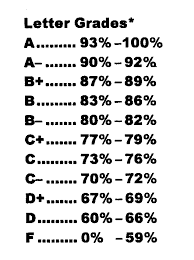
letter grades

Based on your schooling years where would you fall on this line-up and how do you know?

One of the many and most harmful, misguided practices in schools today, is the inaccurate art of grading. It is an art because it is subjective, even though we may use a combination of qualitative and quantitative measures to determine worth or value. One’s view of art compared to another’s is based on their interpretation of the piece. It often depends upon personal preference and experience.

Grading students based on scores collected on a number of miscellaneous pieces of work does not signify or reflect true learning. It just quantifies numerical averages.

Here is the scenario: We teach subjects, students listen and learn. We check to see if they got what we taught. They show us on a test. We reward or punish them with a report card grade that we determine using scores we’ve gathered along the way. We move on to the next topic and repeat the process until the school year is finished. Students get to keep their grades forever. It’s the gift that keeps on giving.

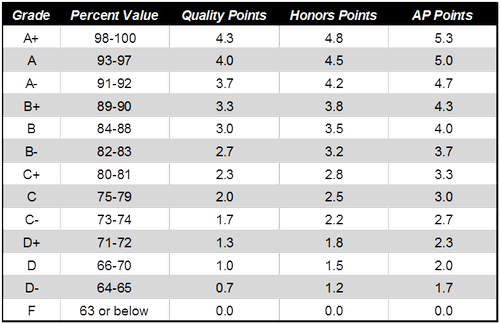
What really goes into a grade? Classwork, homework, tests and quizzes are typically the bulk of grading criteria. However, there are those who strongly believe that attendance, behavior, and effort are viable sources to consider when determining a student’s grade. In fact, there are efforts to quantify levels of “smartness” by using grading practices such as this below.

grades%

Any score of 63% or below skews your chances of upward movement thanks to the honored practice of averaging grades. Two or more zeros ensure that you’ll never catch up or redeem yourself. It’s a done deal and one reason why so many students disengage or quit school. They have lost hope. More importantly, we have given up on them by allowing them to fail our unforgiving system that equates good grades with learning. This happens too frequently.

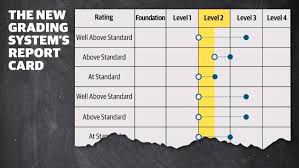
Even with the newer standards-based grading there are subjective factors and uncertainties. We just can’t bring ourselves to say a student either met the standard or they didn’t. That dilemma is in part because we are so conditioned to rank students, especially to honor those who respond quickly and accurately to our teaching. What exactly does well above standard mean? It depends upon who you ask.

standards grading

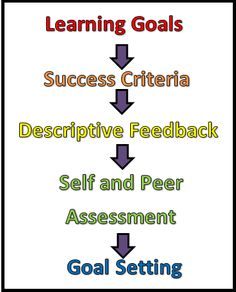
If students were able to self-assess and access what they needed to meet their goals and then work toward that end, it would simplify and perhaps minimize the need for a massive and cumbersome grading process.

“We have done an effective job programming our students to work for rewards by way of grades. Students soon learn that only what is tested or graded counts; the rest is optional.” (Learning Unleashed pg. 103)

Parents expect grades and will balk if there are attempts to change the system. It is familiar and what they know from their own schooling experience. “They also believe that grades tell them how well their child is doing, except when they get a lower grade and question how it happened.” (Learning Unleashed pg. 104)

“Many parents have come to think that how well their child does on their report card has a direct correlation to their status as a parent. We’ve all seen the bumper stickers that say, “I am a proud parent of an Honor Roll Student.” Rarely do we see bumper stickers touting the slogan, “I am a proud parent of an average student.” (Learning Unleashed pg. 104)

honor roll bumper

Grading is one of the sacred school cows that is undergoing more and more scrutiny these days. Many brave teachers, schools and school districts are working to address the inherent flaws with this type of cumulative categorizing, ranking and evaluating.

In my book, Learning Unleashed Re-imagining and Re-purposing Our Schools, I ask this out-of-the-box question.

“If we never had grades and were never told that grades were important, would we still learn anything and how would we know?”

My book offers a reasonable and doable solution. Stop giving grades! Provide written or verbal feedback during the learning process. Stop the practice of telling students what “counts” for a grade. Provide opportunities for students to build their own portfolio of work showing progress and creativity and allow them to explain their growth and goals to others, especially their parents or guardians. Let them own their learning.

This kind of change only comes with consensus and trust on the part of the entire educational community. It is hard work and not for the faint-hardhearted. However, our students need and deserve it. It is long overdue.

no grades

Next in this series: Restrictive and Limited Academic Curriculum

Unpacking the Learning – Part 6

Assessments

Test anxiety is real!

Symptoms

  • Physical symptoms. Headache, nausea, diarrhea, excessive sweating, shortness of breath, rapid heartbeat, light-headedness and feeling faint can all occur. Test anxiety can lead to a panic attack, which is the abrupt onset of intense fear or discomfort in which individuals may feel like they are unable to breathe or having a heart attack.
  • Emotional symptoms. Feelings of anger, fear, helplessness and disappointment are common emotional responses to test anxiety.
  • Behavioral/Cognitive symptoms. Difficulty concentrating, thinking negatively and comparing yourself to others are common symptoms of test anxiety.  Test Anxiety

Life is full of tests – driving tests, health exams, academic and professional assessments, and athletic/endurance testing just to name a few. Most of the time, preparation and practice factor into the testing equation. For school-aged students, taking a test can be the single most anxiety-ridden activity in their academic career.

It really doesn’t have to be that way.

One of the main reasons that test anxiety exists in the school setting is due to the rigid grade level time table and pace of instruction. We assume that all students will learn at the same rate in the same way and demonstrate that learning in exactly the same manner via a paper pencil test. There is little room for deviation and hardly any exceptions to this rule.

Sir Ken Robinson puts it this way, “Learning happens in the minds and souls, not in the databases of multiple-choice tests.”

In particular, high stakes testing seems to drive the pace and delivery of curriculum because we tend to assign those results so much weight and credibility. Both state and federal laws demand that we administer yearly assessments based on the states standards. This practice is explained as a way to ensure educational quality and equity. In reality, it ensures neither. However, it does provide test publishers a certain level of job security.

testing instuments dreamstimesmall_5908127

“It is not unrealistic to consider assessing students, but to what end and for what purpose? Informal classroom assessment is needed, and it is very likely that students themselves can help in the development process. However, the assessments must make sense and be utilized for learning, not grading. This can be very liberating for both the teacher and the student.” (Learning Unleashed pg. 97-99)

This type of assessment is known as formative, which means that the evidence gathered is used to adapt the teaching to meet the needs of the students. Studies show that strengthening the practice of formative assessment produces significant, and often substantial, learning gains.  (Paul Black and Dylan Wiliam in Learning Unleashed pg. 129)

Formative assessment through student observation, demonstration, or some type of performance with relevant teacher feedback enables students to self-assess their own growth and learning. It requires coming alongside the learner as a coach providing feedback and support as needed. It also takes into account that we all learn differently, and at different rates.

When we provide ongoing and specific formative feedback, without the imposed artificial deadlines, learning is inevitable. I refer to this as “goal to goal” learning.

feedback

I have heard it said, (and at one time I’ve said it myself) that interim, end of year, and high-stakes assessments are valuable tools for data analysis and reflection. The data analysis and reflection may serve some teachers, school boards, or those who rank school districts, but there is little to no value for the individual student. They typically can’t review the actual test to see how they performed or how any mistakes might be corrected. In some cases, they may receive a composite score highlighting areas of strength or weakness, but the results are not very informative.

What is even less informative, and generally a waste of time, is when schools/teachers set their yearly goals based on previous year student assessment results. This really makes no sense at all and yet it is often a common ritual as teachers return for a new school year. Proponents believe this type of goal setting practice will increase student performance and teacher effectiveness. My apologies to those I’ve led in this endeavor during my years as an educational administrator. We can all learn from our mistakes. I know I have.

Common Sense Alert: Current students don’t perform better on tests by using former students results and teacher don’t teach better using results from students they no longer have. 

Teachers access plenty of relevant and meaningful evidence every day in their classrooms. Unfortunately, many are under the assumption that almost everything must be tested, scored and averaged together for the purpose of grading. Their teacher prep courses are geared toward that paradigm. Teachers also encounter an almost audible clock ticking away the minutes as they rush to complete the paced curriculum and standards.

When we genuinely examine and understand the realities and nuances of authentic and individualized learning, we might begin to question many of the current school assessment paradigms that tell quite a different story. For too long, the story sounded like this: teach, test, repeat. A new generation of learners demand a different and more relevant approach and outcome and we would do well to listen to them.

Up next in this series: Grading.

Unpacking the Learning – Part 5

School Buildings

“Do we really need to go to a place called school?” Pg. 94 Learning Unleashed Re-imagining and Re-purposing Our Schools.

This one sentence, among others in my book, may cause some bewilderment within the schooling community. Parents and students themselves will have questions. Don’t we need school buildings? Where would students go to learn? Don’t we need facilities in which to feed, teach, test, and conduct various school activities? Shouldn’t there be a safe place where students and teachers can meet to learn?

From the home, to the one-room schoolhouse, to the most expansive and modern school buildings today, schooling has evolved to meet the perceived need of the times. Early on, parents taught their children at home – many still do. As communities grew, schoolhouses offered another option for families. With the industrial age factories came the industrial model of schooling. Over time, school buildings increased in size to handle hundreds and even thousands of students.

New and spacious buildings equipped with plenty of natural light, modern amenities, attached playgrounds, and various sports fields are quite enticing for a family interested in providing the best for their young ones. Often times, these new schools are options for those fortunate enough to live within certain zip codes across the country. Others have no options apart from aging school buildings with multiple structural and cosmetic obstacles. It all depends upon where one lives.

Communities that are able, continue to pour thousands of dollars into erecting the most modern and functional buildings in which to conduct school. Exorbitant amounts of funding are set aside in school district budgets to build these new schools along with the promise of new housing developments to help offset the costs. Parents flock to move into these districts if they can.

In the age of rapid technological discoveries and advancements, it is possible to imagine that school buildings as we know them now, may eventually become obsolete much as the one room school house did. We cling to this model in spite of the current technological and global signs pointing us in a different direction.  Parents may be the most difficult to convince simply because its the model in which they are most familiar.

However, let’s consider an idea that literally takes us out of the proverbial school house and into the world.

When we shift to the coach/facilitator model of teaching where parents and students seek and select “teachers” for their known expertise and success with students, we also open multiple venue options where they might meet as needed. This could  include local places of business, the library, community centers, community colleges, other appropriate partnership locations or the school building itself. Older students may also determine that in some cases online projects/research, apprenticeships, community service or study done at home are viable options.

When we think of learning as only happening in a place called school, we limit the the ways in which students can access information. At one time that made sense, it no longer does. Ideally, a drop-in learning community center where anyone who wants to learn something can go would address a multitude of needs. In addition, anyone who wants to offer classes can do so. Students would sign up to participate based on their interests or needs.

Simply put, learning can now happen anywhere, at anytime, with anyone. This is the school of the future. One, or a few teachers per grade level at a local school with a fixed curriculum, will soon become an archaic educational option. No matter how hard they try, schools will not be able to sustain the industrial-aged model of learning much longer. Informational technology is ushering us into another time and another place in history.

We can drag our feet, kicking and screaming, or we can accept the inevitable and adapt our one-room schoolhouse roots to the new world in which we live.

This is a world where in the blink of an eye we can access almost anything we want to know, understand or learn. It is a world where information changes so rapidly that textbooks are outdated the minute they are printed. It’s a world where teacher preparation courses can’t possible keep up with the most current brain and learning research, scientific advancements or the newest innovations in technology, medicine or communication.  It’s a world where class rank, grades, and GPA are becoming meaningless indicators of an old school paradigm.

The world has changed. Our students have changed. Access to knowledge has changed. Our schools have not changed. They continue to apply well-meaning but band-aid approaches, while offering an ever-decreasing educational benefit.  These valiant efforts take their toll on an institution that can no longer be the main source of knowledge and learning. It’s an unsustainable expectation.

A new vision and reality awaits those who are willing to embrace it.

“Educational visionaries are few and far between, but when you find yourself looking into the eyes of a young person and seeing their incredible future, you have arrived.”  Evonne Rogers

Unpacking the Learning – Part 4

Class Sizes

There is a known phenomenon that occurs when you cram too many people into a small space.  It gets crowded, uncomfortable, and makes it hard to breathe.

“Phone Booth Cramming was a late-1950s fad with a simple premise: cram a phone booth full of dudes (and/or ladies) and take a picture before the people on the bottom suffocate.” Words to the wise from a student who participated…”People at the bottom were really laboring to breathe.” More info here click link

The same outcome occurs when you cram too many young people into a small learning space and think its okay. Psychological studies have indicated that overcrowding can cause chronic stress, increased irritability and aggression, as well as lack of privacy which can lead to depression. While most studies examine living conditions, one could make an argument that classroom cramming can also have negative effects.

No one knows the magic number when it comes to determining the optimal amount of students in any given learning environment. In most schools, this determination is usually based on a district’s yearly budget. There are so few studies on this topic, more than likely due to the budget implications, so we just accept the status quo.  Even when the mid 1980 STAR studies (pg 92-93 in Learning Unleashed) did demonstrate a strong correlation between smaller class sizes and student performance results, it was not embraced by most schools around the country.

From a parent and teacher perspective, a small class means more attention for all students, especially those who may need more support. Having fewer students offers a multitude of student learning benefits that are absent in larger classes. At least in some states, legislators have decided that younger children may need more attention and therefore they provide funding for smaller class sizes in the early years. Wisdom occasionally surfaces at the legislative level.

The large class conundrum forces teachers to employ various “behavior management” techniques in order to keep the classroom running smoothly. Bribery tactics and coercion are in full force to maintain calm and ease any distractions. Children are programmed early on to know and understand that they are “good students” if they accept the bribery du jour and adhere to the coercion efforts.

In my book, Learning Unleashed – Reimagining and Repurposing Our Schools,  I propose class sizes of around 15 students. I am sure that any school board member, superintendent, or district office manager knows this is next to impossible. I thought this when I was an assistant superintendent.  On the surface, and given the budget constraints, it is impossible within our current schemata of school.

The costs of running a school district are staggering. Most of those costs are regulated by unfunded or far less than fully funded mandates. Our federal and state legislators continue to write laws that place extraordinary burdens on the average school system. Money that is allocated is earmarked for specific purposes leaving a school district’s hands tied.

A good example is the federal Title I dollars that schools scramble to spend before the imposed deadline. The federal guidelines strictly states that it cannot supplant programs the district normally operates within their own budget. The allocated funding can only supplement these programs. It also outlines specific ways in which this funding can be spent. There is little choice for local school districts.  Elected officials continue to dictate what they believe is best for our schools and our students.

In addition, certain school programs have exorbitant and sometimes unknown expenses that the district must absorb. Yearly school budget proposals are developed to plan for the worse case scenario while the district waits and hopes for the best. Therefore, local schools are left with a constant leaking faucet, often forcing them to make the most cost effective decisions rather than more learning effective ones.

The “seeing is believing” phenomenon is another drawback which proves an even larger impediment to changing anything in schools. Trying something different or new is often seen as a waste of time. It is easy to understand why school folks are less than enthusiastic with new initiatives since they tend to surface about every five years or so accompanied by a sometimes painful training process. It is important to note that most of these changes have little to do with the basic structure of schooling. That is an untouchable.

Credit to Tom Guskey below.Guskey innov
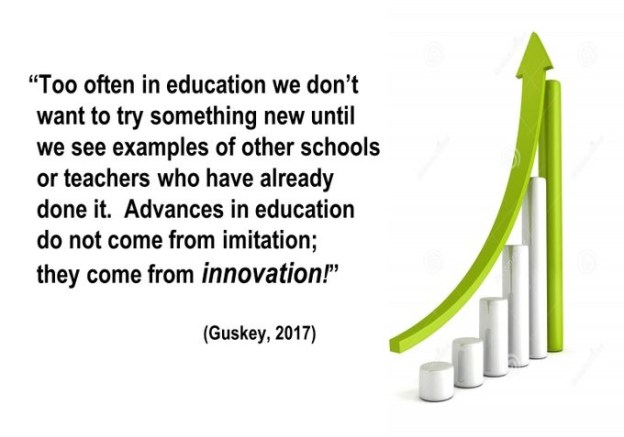
Within public schools, the best we can hope for is to stay afloat while ever-increasing external demands suck the life and joy out of real, individualized and authentic learning for every school aged young person.

In the perfect world of anytime, anywhere learning where parents and children chart their own journey, attending a public school becomes a choice not a mandate.

For those of you who hate to read long blogs, I apologize now. For those of you who don’t mind reading on here is how this might play out on any given school day. Cost savings are noted with an asterisk. *

  • Students are not assigned to teachers. Teachers are chosen by parents and students for their coaching/content expertise and rapport with children.
  • Teachers are not solely evaluated by the school district but included is an effectiveness rating from their clientele (former and current students and parents). High stakes test results are not used to evaluate teachers.*
  • Teachers provide an online presence to families that include but is not limited to the following: educational philosophy, copy of credentials, professional resume, samples of successful school projects, informal student performance data, etc.
  • Teachers who do not have a track record of success via district, parent/student evaluation are then offered support by the district. If support has not improved agreed upon results within an agreed upon time frame, then teachers are terminated. Teachers agree to this process when hired.*
  • Teachers work in teams to carry the daily case load of up to 15-20 students each but can work with as many as 60-70 students a day depending upon age level as they rotate among the team of teachers.
  • Newer teachers are paired with seasoned teachers.*
  • Students are not assigned letter or number grades which allows the teacher more direct contact with students.  For the Love of Learning – Not grading – click here Students self evaluate at regular intervals.*
  • Parent conferences are scheduled at regular intervals as needed.
  • Students stay with this team of teachers for at least four years unless parents choose other educational alternatives or teachers change. Students are not grouped in grade levels.*
  • Teachers utilize the non-student contact hours (remember from my previous blog there are shorter hours that students attend school) for professional development (PD) that suits their particular need not a district mandated in-service, except those required by law. Teachers share their learning with their team. They may also choose to record their PD efforts and subsequent change of practice or enhancement to their practices on their websites as reflection or to provide updates. *

This scenario empowers the families, students and teachers by creating the conditions for more ownership, personalized learning, and academic growth. It also assumes that our current school system structures are re-purposed to accommodate this model. For those of you wondering how this could ever happen in a public school,  please read further.

When you empower teachers with built in accountability, there is less need for management or an elaborate evaluation process. There is also less need for teacher unions. When you trust the teachers you have hired, there is less need for oversight and control. When you offer your community a proven commitment to ensure that student learning is your top priority, there is more likelihood of continued success.

Over time a district hires less managers (district and school level) and more teachers as the priority shifts. A district pays less for PD and costly data management systems as well as the central office staff to plan and implement.

We tend to think that new and shiny buildings equate to a better learning environment with smarter and happier children who will then perform better on tests. Learning can happen anywhere at anytime so there is less need to build newer and more expensive schools. Maintaining current buildings is costly enough. Utilizing partnership facilities such as the local library, community centers, religious facilities, or community colleges opens up a whole world of possibilities.

This type of school can exist in the publicly funded version of schooling but it would take some time to convert all the skeptics and to pry ourselves loose of crippling regulations. It would require out-of-the-box thinking, something very foreign in school systems.  In addition, we must stop spewing our arrogant notion that parents are not educators, have not been formally trained, and therefore can’t possibly know what’s educationally best for their child. Unfortunately, we have convinced them of that. Parents as partners must become more than just a catch phrase or school PTA slogan.

We have to embrace a new kind of thinking where schooling no longer exists to educate the masses for the work world that awaits them. The work world has changed and so should schools. For it to survive, it must totally transform itself – now.

For those who can’t wait any longer, you might try other options like homeschooling, co-ops, Sudbury, a good charter school or democratic/progressive schools. Sadly, many of us just wait and hope.

The bottom line – public schools must change or be left behind.  In their present state, they are grossly out of touch with the new kind of learner and forever doomed to the lowest common denominator mentality. Forced grade level curriculum, a massive obsession for testing, and the need to rank, sort, and compare students, teachers and their schools guarantee this result.

“I am entirely certain that twenty years from now we will look at education as it is practiced in most schools today and wonder that we could have tolerated anything so primitive.” – John W. Gardner

Unpacking the Learning Part 3

Length of the School Day and School Year

Q: How long is enough time for a child to learn?

A: As much time as they need.

I wish it was that simple. In reality, we have determined that the old agricultural calendar still serves a purpose in the big scheme of schooling.  Many believe that tampering with this archaic relic is a waste of time and energy. Time-honored traditions are hard to change, especially when the alternatives seem so daunting.

Obviously schools have tried variations on this theme with a modified school calendar hoping that it will yield good results for all parties involved. However, there are problems inherent with modified calendars as well as traditional ones. They suggest that the time allotments make sense for everyone. They don’t.

Time to learn is so unique that we can’t even imagine what that might look like apart from the current 6-7 hour grade level, compulsory school day and 180-185 school days a year mindset.  The rationale that says more time in school equals more learning is widely accepted as fact.

In a cursory review of the main research studies done on the correlation between more time or extended time in school and its effects on student achievement, one finds a common thread. More time in school such as preschool or all day Kindergarten, does not translate to lasting benefits much beyond the primary grades.  It is also noted that the quality of time is the most reliable indicator of success. 

Of greater interest to me is how we use the time we already have in school. Schools are “childcare” institutions, sports arenas, social events magnets, health, welfare and nutrition monitors, technology advancers, curriculum police, student sorting and comparing culprits and the one-size fits all organizer of information. We have all acquiesced to this belief system, so schools work tirelessly, on a daily basis to ensure they operate with all this in mind.  It’s no wonder people think more time is needed. How do we fit it all into a day?

In order to effectively teach “all” the current standards for each grade level subject, a teacher would need a solid block of uninterrupted daily time with nothing else scheduled.  I have heard that in order to present all the material in most grade level standard documents, one would need about twenty three years to cover it. There is always a sense of urgency to keep moving forward for fear of lagging too far behind. The evidence of this delay will no doubt appear obvious on end-of-year assessments, therefore teachers are forced to keep the determined fast pace.

Teachers, whom I highly respect, often tell me that this is one of the most frustrating parts of their job. They wish they could spend as much time as each child needs.  They see time slipping away and can’t do much about it apart from offering their own lunch or planning time to help their students. This is not a fair fall back and is totally random depending upon teacher willingness. Sometimes after school or summer programs are seen as the answer to this problem of time, but are they really effective and how do we know?

Additionally, teachers say they need far more time to collaborate with their colleagues than their current schedules allow. This is why there is often teacher burn-out or the need for a “summer vacation” to recoup. This is also true for students and one of the many reasons why after-school and summer school programs often have low attendance rates and less than reliable data to demonstrate their worth. Parents have also come to rely on the summer months to plan vacations, summer camps or other family oriented outings.

In my book, Learning Unleashed, I propose a radical, but doable solution to the question of time. “Minimize the school day to four or five hours…Non-mandated schooling hours and days per year allows parents the freedom to choose other appropriate options for their children without the threat of punishment by law.”  (Pg. 90) Fewer hours for all students and less hours for younger ones aligns better with results found in developmental psychology studies that rarely find their way into our schools. Wait, doesn’t less time in school seem counter intuitive? Let’s unpack these ideas a bit further.

As stated in one of my earlier blog post, getting rid of grade level configurations would greatly address the problem of time. If teachers could utilize pretests, both academic and interest-based, to group students for learning without the age requirement, the likelihood of greater teacher and student engagement in learning would be increased. Teachers and students would be able to stay with the learning until evidence proves that learning was achieved. The concept of individualized mastery learning would take on a whole new meaning.

For example, a typical third grade curriculum mandates that every student masters certain multiplication facts with automaticity by the end of a grading period. We know that all students don’t meet this performance level within the given time frame. So we just march on to the next set of facts and grade students accordingly. Those who have failed to meet our deadline are now overwhelmed with more facts to keep straight and a failing grade as incentive to do better. This is often an irretrievable downward spiral that resurfaces each year thereafter. Junior high teachers are left scratching their heads wondering how these students got this far without knowing their multiplication facts.  It soon becomes apparent that something is terribly amiss. How can they do Algebra when they can’t multiply?

timestablechart-

It is true that multiplication involves memorization, but for so many students this is where the breakdown and math anxiety begins. Statistically, there is a notable drop in math scores across the country in fourth grade. If we could stop the practice of timing when the learning should occur and just stay with the child for as long as it takes without punishment, they just might experience success. It may take 2 months, 10 months, 12 months or longer for a student to master a particularly pesky challenge. We don’t make those kind of exceptions in schools, we just pass them on to the next round of grade level standards hoping they’ll manage to catch up somehow. Or worse, we retain them to repeat the grade level they just managed to botch.

I have heard teachers tell their students and parents that they will not be spending any class time beyond the basic introduction to the multiplication facts because students just need to memorize them on their own time. Maybe students really can teach themselves.

Helpful Reminders  (click on the link)

Attention spans, interest levels, need for rest, exercise and play all point to a shorter school day. Tapping into peak learning times by starting later and ending earlier might address the early morning/late afternoon slump syndrome, a low energy issue that so many children experience. Ask any teacher to gauge the productivity level of the students in his/her classroom at the beginning and towards the end of a long day and hear a common response, “It takes a while to prime their pumps in the morning and at the end of the day they are so DONE and so am I!” Having students practice, for 12 years, the endurance test of long hours in school as preparation for the real work world is cruel and unnecessary punishment.

Not rushing to cover all the grade level standards within a ten month time frame is exhilarating. Not having to assign a failing grade to students who don’t meet the deadline, values and redeems learning whenever it happens. Less grading and less recording, allows more time for engaging with the students who are there to learn. It’s what every good teacher wants and what their students desire.

Schools must be willing to adapt to a new world, one where young people can access information on demand. They must also pry their hands loose of strict time constraints and allow for flexible learning time and space. They must seek authentic learning opportunities that take children and young people out of the four walls of a classroom as often as possible. They must also give up the dictatorial mandate of compulsory schooling recognizing that a menu of educational options is more in keeping with where we are headed in every other quest for knowledge and information. Simply put, they must relinquish CONTROL.

If school were not compulsory and parents could access it as one of many options for getting an education, re-imagining school time might look something like this.

  • Younger students, (6-11) can choose to attend school between 9:00 a.m and 1:00 p.m. this includes 20 minutes for lunch and frequent short free play breaks.
  • Older students, (11-15) can choose to attend school between 9:00 a.m. and 2:00 p.m. this includes 20 minutes for lunch and at least one or two quick, unstructured breaks.
  • Students 16-17 years or older might spend their last “school” year(s) in an apprenticeship, mentorship, work study, or travel study program. This is a parent and student choice with teacher input as needed.
  • When teachers are not in direct contact with students, time for planning, collaborating, communicating with families, and in some circumstances, attending school or district meetings will fall within their regular 7-8 hour negotiated work day/year.
  • Students (6-11 yrs old) are matched (with parent input) with two or three teachers that stay with them for the entire time. Mastery goals are set by the teacher and student with incremental check-ins, not by age or required end of a school year deadlines. Student progress is monitored and communicated via parent/student/teacher conferences, not report cards. If a student meets all the mastery goals before the five years, they are free to join the 11-16 groups.
  • Students (11-16) are matched (with parent input) with three or four teachers that stay with them for the entire time. Mastery goals are set by the students with teacher feedback. Progress is monitored and communicated via parent/student/teacher conference, not report cards. Students are free to choose independent study research/projects, etc. if they reach mastery goals before they are 17.
  • Parents may choose, in combination with school or not, other educational opportunities as well. These might include online courses, home schooling, community college classes, experts in their fields for mentoring, neighborhood service or religious oriented clubs and organizations as well as a myriad of other learning venues.

This scenario would work best in a school structure that values learning above sorting and testing. It presumes that children are more engaged when they have more control over their own learning without threat of punishments or bribery with rewards. It assumes that teachers nurture and follow the student in the natural flow of learning. Teacher teams share the coaching based on their expertise. It functions as a vital opportunity for those who choose to access it. It’s purpose clearly becomes student-centered and student driven. Teachers are sought out for their value as a coach/facilitator/mentor and are recognized as such with a salary that honors their contributions.  (I am not referring to merit pay here.)

This scenario also assumes that school does not exist to provide free child care for working families. That is not its purpose, nor should it be. It embraces the notion that parents are responsible for the education of their children, not the school. Parents are vital in this equation: Parent + Student + Teacher/Mentor = Learning.

For families living in poverty who may need extra support from their community, schools could partner with existing child care entities who offer supervised play, activities, or field trips before or after school times.  This partnership would be locally determined and locally funded. Many already exist in our inner cities as well as rural areas. Some offer low cost options and some offer scholarships that are funded through grants, endowments, and donations.

Many believe that universal preschool would level the playing field and address a pressing problem for low income or poverty level families. However, years of data collected on Head Start and similar preschool programs has not shown any significant long term learning benefits for its participants.  As stated earlier, studies have shown the quality of time spent is far more impactful than the time itself.

As long as public tax dollars support public education, there will be those who demand strict accountability. Rather than high stakes tests, punitive teacher sorting, or infighting over school choice options, can’t we all agree on one important factor? The best evidence of accountability is when we have effectively prepared young people to become productive and contributing citizens in their communities and world regardless of which educational avenue they access to get there.

This kind of accountability can only be measured one young person at a time in a culture that values all kinds of learning and all kinds of students. Anywhere, anytime learning is the future.        

Time Tolkien)